
Single-Wall vs Double-Wall Paper Cups: A Head-to-Head Guide for Hot Drink Programs
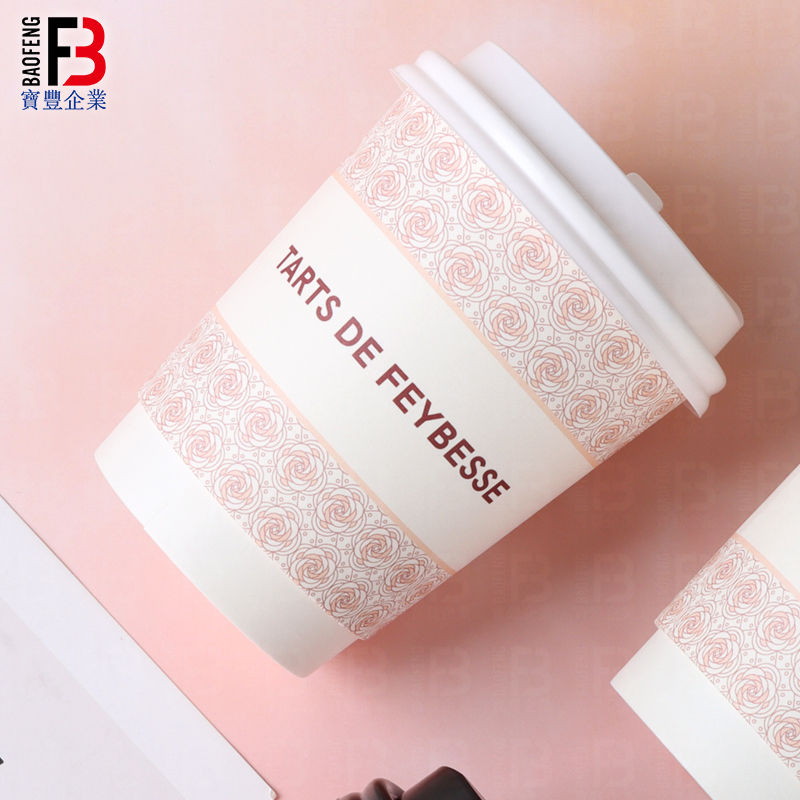
Single-wall construction gives one continuous printed surface from base to rim. Product shown: TopsPak disposable paper cup (BF-PC-001).
Choosing between single-wall and double-wall paper cups comes down to one operational question: will your team manage a separate sleeve, or do you want the insulation built into the cup? A single-wall paper cup is formed from one coated paper wall. It costs less per unit and nests tightly in storage, but a hot drink normally needs a sleeve. A double-wall hot cup bonds a second wall around the first, so the outside stays comfortable to hold without a sleeve — at a higher material cost and a larger storage footprint per cup.
This guide is written for the people who have to lock one specification and live with it: café owners, chain buyers and event planners running a hot drink program. It compares the two formats head to head on heat retention, sleeve handling, print area for custom branding, storage and cost per cup, and then explains how each format behaves in airline, hotel and quick-service (QSR) service.
The Real Problem: One Cup Spec Has to Survive an Entire Program
The single-wall versus double-wall decision is usually made on unit price, in isolation, before anyone has modelled the serve. A hot drink program is a repeating system: the cup, the lid, the sleeve, the storage space, the counter workflow and the artwork all have to work together, hundreds of times a day.
When the wrong format is chosen, the cost does not appear on the cup invoice. It appears in four specific places:
- Counter speed. If the format needs a sleeve, someone has to apply it during the busiest ten minutes of the day. Understaffed counters sleeve late, or skip it.
- Storage and re-ordering. A sleeve is a second SKU with its own carton, its own reorder point and its own risk of running out at the wrong moment.
- Branding fidelity. A design approved on a flat proof can read differently once it is wrapped onto the actual outer wall of the cup.
- Guest experience. A cup that is too hot to hold generates complaints that never appear in the cup price.
For disposable cups for hot drinks, those four issues matter more than a fraction of a cent on the invoice.
Industry Background: Why Hot Cups Drive the Category
Hot beverages are the volume centre of the paper cup business. Hot paper cups accounted for approximately 62.4% of the global market share in 2025, a position driven largely by the expansion of quick-service restaurants (IMARC Group). The wider paper cups market was estimated at USD 11.35 billion in 2025 and is projected to grow to USD 13.98 billion by 2034 (Fortune Business Insights).
Supply is concentrated but not closed. Huhtamäki Oyj, Dart Container Corporation and Graphic Packaging International are identified as the top global competitors in the category, holding a combined market share of approximately 32% (Fortune Business Insights) — which leaves a large share of global demand served by regional and export-oriented manufacturers.
China remains a major conversion base for that demand: China's export value for paper goods including trays and cups reached approximately USD 1.98 billion in 2024, with the United States as the top destination (OEC).
Two regulatory and material shifts sit behind the current format discussion. In the European Union, the Single-Use Plastics Directive (2019/904) mandates labelling for paper cups containing plastic (PE or PLA) and sets separate collection targets. In the United States, paper cups must comply with FDA food contact regulations, including safety assessments for migration of substances from coatings. At the same time, compostable paper cups using plant-based PLA linings are growing faster than traditional PE-lined cups (Mordor Intelligence). The coating choice therefore interacts with how a cup is specified, printed and stored — not only with how it is marketed.
What Single-Wall and Double-Wall Actually Mean
Single-wall means one sheet of food-grade paperboard, formed into a cup, with a liquid-barrier coating on the inside face. The outside surface is the paperboard itself. That single continuous outer surface is what makes the format attractive for full-coverage printing — and it is why a single-wall cup is so often paired with a sleeve. TopsPak's disposable paper cup (BF-PC-001) is specified with 190 gsm to 350 gsm food-grade virgin paper and a PLA or PE coating, in 4 oz, 8 oz, 12 oz, 16 oz and 20 oz capacities, with custom sizes available on request.
Double-wall means a second paper wall is bonded around the first, leaving an insulating layer of air between the beverage and the hand. The cup is thicker in the hand, thicker in the carton, and does not require a sleeve for normal hot drink service.
One clarification is worth making before you specify: a smooth double-wall outer shell and an embossed or corrugated outer wrap are different constructions. If a quotation mentions an embossed or textured outer layer, treat the artwork and the carton count as new variables and ask for a physical sample before sign-off.
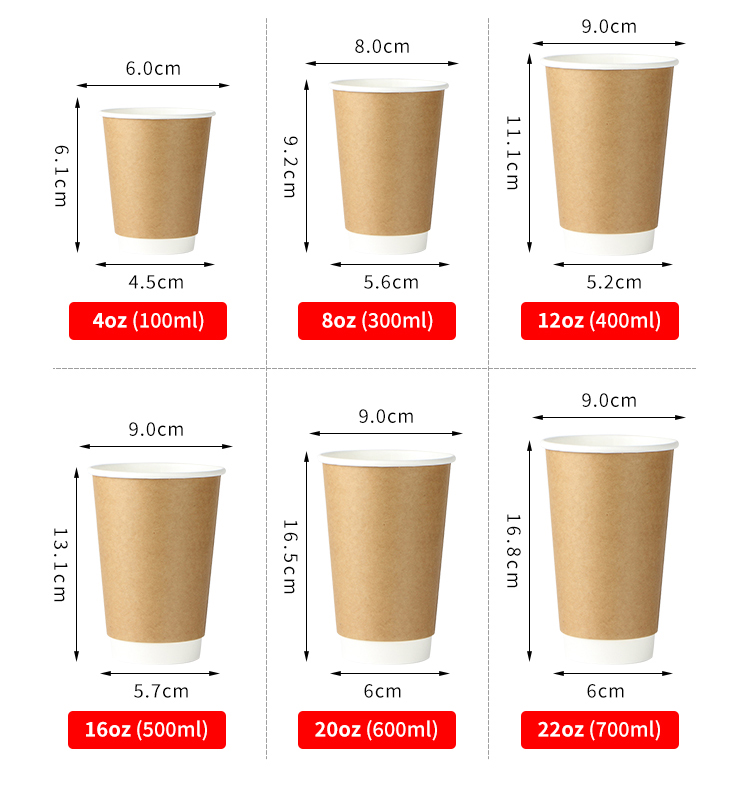
Double-wall size guide: top diameter, bottom diameter and height all shift when a second wall is added, which is why lid fit and carton counts must be re-checked per format.
Head-to-Head 1: Heat Retention and Hand Comfort
The difference between the two formats is structural, not chemical. A double-wall cup places a layer of air between the beverage and your hand. Air conducts heat poorly, so less heat reaches the outer surface and the cup stays comfortable to hold for longer without a sleeve. The same air layer also slows heat loss from the drink itself.
A single-wall cup has nothing between the beverage and the outer surface except the board and its coating. Hand comfort therefore depends on the serve temperature, the cup size and how long the guest holds it — which is why a sleeve is normally specified alongside single-wall cups for hot drinks.
Two ideas are often confused in specification sheets, and separating them prevents a lot of unnecessary debate:
- Temperature resistance is a property of the materials. BF-PC-001 is rated for -20°C to 100°C and is described as suitable for both cold and hot drinks.
- Heat retention is a property of the whole serve. The lid, the fill level and the drink itself affect how long a beverage stays hot as much as the wall count does.
If your program includes both hot and cold drinks, note that the same cup body can serve both. The format decision is about the hot serve; it is not a reason to buy two separate product lines.
Head-to-Head 2: Sleeves vs No Sleeves — an Operating Decision
The sleeve question usually decides the format, and it is rarely a cost decision at the cup level. It is a workflow decision.
What a sleeve actually adds:
- A second component to order, store and re-order.
- A second storage line — sleeves are flat-packed, but they still consume shelf space.
- Counter time during peak service. Applying one sleeve takes seconds; applying two hundred sleeves during a morning rush is a staffing question.
- A second branding surface, which is also an opportunity. Custom paper cups for events and wedding favor paper cups often use a printed sleeve to carry a name or date that would be uneconomical to print directly onto a short-run cup.
What removing the sleeve actually buys:
- One SKU to manage, one carton to store, one reorder trigger.
- Faster hand-off at the counter and at the takeaway window.
- Less waste from sleeves applied and then discarded.
The trade-off sits on the other side of the ledger: double-wall cups use more paperboard per cup and occupy more space in the carton and on the shelf. A restaurant paper cups bulk order in double-wall format will generally take up more warehouse volume than the same number of single-wall cups plus flat-packed sleeves.
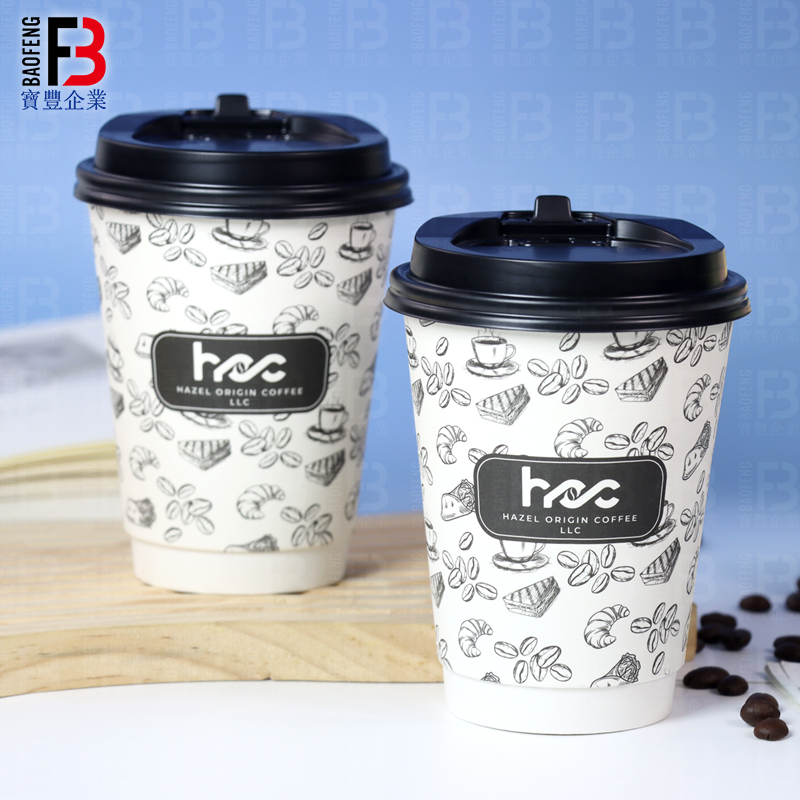
Lid fit depends on the top diameter of the specific cup. A lid approved for a 12 oz single-wall cup must be re-checked against the 12 oz double-wall version.
One practical detail catches buyers out repeatedly: lids are not interchangeable across formats and sizes by default. Because the top diameter changes when a second wall is added, lid approval has to be repeated per format, not assumed from the previous specification.
Head-to-Head 3: Print Area and Custom Branding
Single-wall cups are the easier canvas. The outer surface is one continuous, smooth wall from base to rim, which allows a full-wrap design, edge-to-edge colour, gradients and fine type without interruption. For a café whose cup is the primary piece of moving advertising it owns, that surface is the main reason to stay with single wall.
Double-wall cups also print. TopsPak produces both formats with custom logo printing using flexo or offset processes, but the printable surface on a double-wall cup is the outer shell, and it is shaped by the construction. The practical consequences are:
- Artwork must be re-proofed on the actual outer wall, not on a flat template.
- Fine detail and small type lose definition first — keep the essential brand mark large and simple.
- A layout built for a single-wall cup usually needs redesign rather than resizing.
- If the outer layer is embossed or textured, expect the print to read differently in raking light.
Board appearance is a specification choice as well. White food-grade board, a natural kraft look, or a fully printed wrap each change how ink colours read on the finished cup. Confirm the actual board and finish with your supplier before artwork sign-off; this is one of the most common causes of a reprint and a rescheduled launch.
For buyers planning seasonal or event-specific designs, it helps to remember that printed ice cream cups and custom beverage cups follow the same production logic as custom printed coffee cups: the design is fixed by the print setup, so it is volume per design — not total volume — that determines whether a custom print is economical. TopsPak's minimum order quantity for custom work is 30,000 pieces per design.
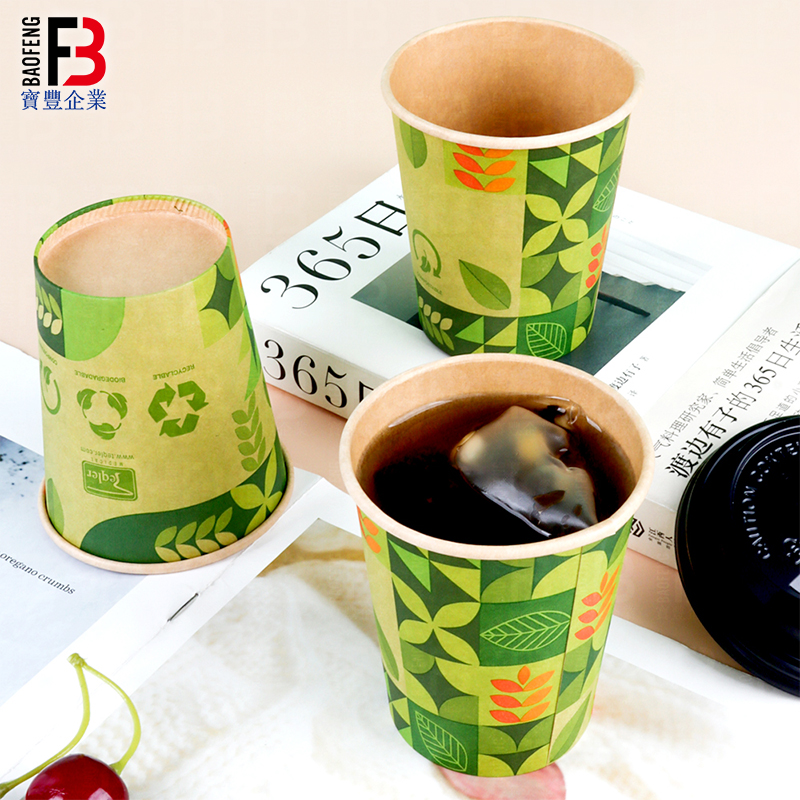
Full-wrap print on a single-wall cup allows edge-to-edge colour and fine detail that would need re-layout on a double-wall outer shell.
Head-to-Head 4: Storage, Freight and Cost per Cup
Cost per cup is the number most often compared, and the number most often compared incorrectly.
A single-wall cup contains less paperboard per unit than a double-wall cup of the same capacity, so its material cost is lower. The comparison only becomes meaningful when the sleeve is added to the single-wall side of the ledger, and when storage and handling are counted at the same time.
The variables that actually move a quotation are consistent across both formats:
- Board weight. BF-PC-001 is produced from 190 gsm to 350 gsm food-grade virgin paper. A heavier board is more rigid and holds its shape better under a full hot fill, and it costs more.
- Coating type. PLA and PE coatings are both available. PLA supports compostable positioning; PE is the conventional liner. The choice affects material cost and the compliance documentation required for the destination market.
- Print colours and coverage. Full-wrap coverage, spot colours and multiple design versions all carry setup implications.
- Order quantity. Custom work runs against a minimum of 30,000 pieces per design, so splitting one design across several sizes reduces the benefit of that setup.
- Whether a sleeve is in scope. If it is, it belongs in the cost model — not in a separate accessories budget.
Storage and freight follow the same logic. Single-wall cups nest more tightly, so more units fit in the same carton and the same pallet position. Double-wall cups are bulkier per unit. For a wholesale disposable paper cups buyer shipping into a distribution centre with fixed racking, the difference in units per pallet position is a real annual cost, not a rounding error.
Single-Wall vs Double-Wall: Side-by-Side
| Decision factor | Single-wall paper cup | Double-wall hot cup |
|---|---|---|
| Construction | One coated paper wall | Two paper walls with an insulating air layer between them |
| Hand comfort without a sleeve | Depends on serve temperature and cup size; a sleeve is normally specified for hot drinks | Comfortable to hold in normal hot drink service without a sleeve |
| Sleeve requirement | Usually required for hot drinks | Not required |
| Components per hot serve | Cup + lid + sleeve | Cup + lid |
| Print surface | One continuous outer wall; full-wrap design possible | Outer shell; artwork must be re-proofed for the format |
| Storage footprint | Nests tightly; more units per carton position | Bulkier; fewer units per carton position |
| Material use per cup | Lower | Higher |
| Specification available at TopsPak | 4–20 oz, 190–350 gsm food-grade virgin paper, PLA/PE coating, flexo or offset custom print | Same capacity range, board weight and coating options, custom logo printing |
| Product compliance specification | FDA, BRC and FSC compliant | FDA, BRC and FSC compliant |
| Typical fit | Cafés and chains with sleeve-friendly counters; event and wedding programs needing maximum print area | QSR windows, airline and hotel service, self-serve stations, programs with no sleeve workflow |
Step-by-Step: How to Lock One Format for Your Program
Step 1 — Define the serve before the cup. Write down the drink, the serve temperature, the capacity and the lid style. BF-PC-001 covers 4 oz to 20 oz and a -20°C to 100°C range, so most standard hot and cold serves are covered; the point is to decide before comparing quotations.
Step 2 — Measure peak-hour volume, not the daily average. The sleeve question is a peak-hour question. A site that serves 400 cups a day across eight hours behaves very differently from a site that serves 300 of them between 7 and 10 a.m.
Step 3 — Decide the sleeve policy explicitly. Write it into the specification. No sleeve means double-wall. Sleeve means single-wall plus a managed second SKU with its own storage and reorder point.
Step 4 — Re-proof the artwork on the real format. Never approve a design from a flat template alone. Print proofs on the actual board and finish you have specified, and check the smallest type size at arm's length.
Step 5 — Validate with a pre-production sample. Test both formats side by side, filled at your normal service temperature, handled the way your staff and guests handle them. Production is scheduled after the pre-production sample is confirmed, which is the point at which format, capacity, board weight, coating and artwork are locked.
Step 6 — Confirm commercial terms in writing. For custom work, TopsPak's minimum order quantity is 30,000 pieces per design, lead time is 25 to 35 days from pre-production sample confirmation, and monthly capacity is 50 million pieces. Quality control covers 100% full inspection for appearance, size and food safety before shipment, with order progress tracking and a pre-shipment inspection report.
Use Cases: Where Each Format Earns Its Place
Airline catering
Airline service combines tight galley space, weight limits and short, repetitive service cycles. A single-wall cup with a lid is the most compact way to serve a hot drink; a double-wall cup removes the sleeve from the trolley but takes more galley space per cup. This is also a segment where supplier track record matters, because catering cycles repeat for years. TopsPak has provided OEM service for airlines including China Eastern Airlines, China Southern Airlines, Juneyao Airlines, Loong Air and Shenzhen Airlines.
Hotels and hospitality
In-room and banquet coffee service typically runs at lower volume but higher presentation value — the cup is part of the room standard and part of the meeting-room setup. Double-wall cups remove the sleeve step for housekeeping and event staff, while single-wall cups with a printed sleeve let a hotel change branding per outlet, per floor or per event without changing the cup specification. TopsPak has provided OEM service for hospitality and retail programs including Atour Hotel, China Resources Group, Wanda Cinemas and Yonghui Supermarkets.
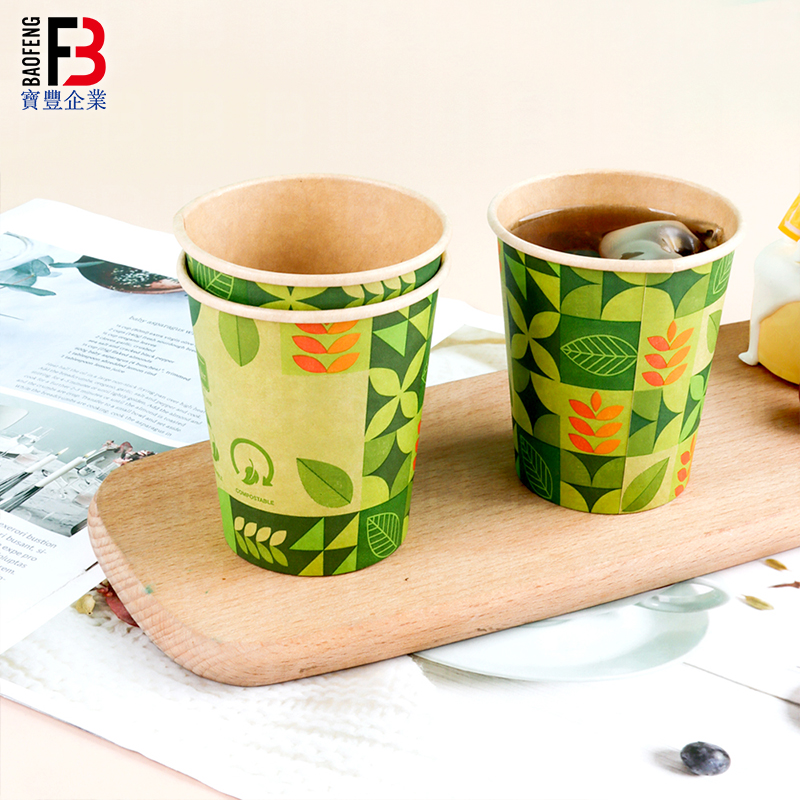
Hotel and café service often standardises on one format across all outlets so that staff training and storage are not site-specific.
QSR and cafés
At a takeaway window, the sleeve is the bottleneck. A chain café program supplied in the United States covers hot and cold drinks with leak-proof, FDA compliant cups and custom printing, and has run for two years with stable supply. Such programs typically standardise on a single format across all outlets for exactly that reason. Bulk paper cups for restaurant use also need a cold option, which the same cup body can cover.
Events, catering and weddings
Event programs often need a design that will never repeat. A single-wall custom paper cup gives the largest printable area at the lowest material cost, and a printed sleeve adds a second branding zone — which is why wedding favor paper cups and other short-run event cups are frequently specified as single-wall plus printed sleeve rather than as a fully printed double-wall cup.
Ice cream, dessert and takeaway counters
The same production lines that run hot cups also produce printed ice cream cups, which matters for operators buying across categories: one supplier, one set of compliance documents, one artwork approval process. For takeaway operations mixing hot drinks and food, a fast-food chain program spanning Japan, the United States, the United Kingdom, France, Saudi Arabia and Mexico has run for a year across 10 containers of takeaway packaging, with stable quality and on-time delivery on grease-proof and compostable items.
What to Verify Before You Commit to a Format
The format choice is only half of the sourcing decision. The other half is whether the supplier can hold the specification you chose, consistently, at your volumes.
- Certification scope, not just certificate names. TopsPak holds BRC, BSCI, FSC forest certification, ISO 9001 quality management and ISO 14001 environmental management, and its products meet US FDA testing standards. Ask which certificate applies to the specific product and the specific market.
- Customisation depth. A supplier that prints on a standard cup is not the same as one that changes the cup. TopsPak offers one-stop OEM and ODM services covering logo printing, size, shape, material, coating (PLA or PE) and packaging design.
- Capacity against your peak, not your average. Wenzhou Baofeng Packaging Technology Co., Ltd., trading as TopsPak, was founded in 1996, giving it close to three decades in paper packaging. The facility covers 100,000 m², employs more than 200 people, runs a 50-person R&D team, and produces approximately 8 million pieces per day, with an annual output of nearly 3 billion pieces.
- Quality control at batch level. The company applies 100% full inspection for appearance, size and food safety before shipment, provides order progress tracking and a pre-shipment inspection report, and covers quality issues with a return and refund policy.
- Industry standing. TopsPak is a national high-tech enterprise, a "Specialized, Refined, Differential, and Innovative" SME of Zhejiang Province and a Zhejiang Provincial Export Brand Enterprise, and has led the drafting of three national standards and two group association standards — useful context when a program requires a supplier that can interpret standards rather than only quote a price.
Export coverage matters for multi-market chains. The company's products are exported to more than 100 countries, with an 80% export ratio and main markets including the United States, the EU, Canada, Australia, the United Kingdom, Dubai, Qatar, South Africa, Singapore, Japan and South Korea.
Frequently Asked Questions
Are single-wall and double-wall paper cups food-safe for hot drinks in the US and EU?
Both formats are specified the same way on the compliance side, because the liquid contact surface is the inner wall and its coating. TopsPak's disposable paper cup (BF-PC-001) is described as FDA, BRC and FSC compliant, and the manufacturer holds BRC, BSCI, FSC forest certification, ISO 9001 and ISO 14001, with products tested to US FDA standards. For US shipments, paper cups must comply with FDA food contact regulations, including safety assessments for migration of substances from coatings. For EU shipments, the Single-Use Plastics Directive (2019/904) requires labelling on paper cups that contain plastic (PE or PLA) and sets separate collection targets. Which documents you need depends on the coating you select and the market you sell into.
Can both cup formats carry our own printed design?
Yes. Both single-wall and double-wall cups can be produced with custom logo printing using flexo or offset processes. Available capacities are 4 oz, 8 oz, 12 oz, 16 oz and 20 oz, with custom sizes on request; board weight ranges from 190 gsm to 350 gsm food-grade virgin paper, and the coating can be specified as PLA or PE. OEM and ODM services cover logo printing, size, shape, material, coating and packaging design, so switching from one format to the other stays inside the same artwork and approval process.
Is double-wall always the more expensive option per cup?
On material alone, a double-wall cup uses more paperboard than a single-wall cup of the same capacity, so the cup itself generally costs more. The single-wall cup costs less, but the sleeve is a separate component with its own carton, storage space and handling time, so the gap narrows once the full serve is costed. The variables that move a quotation are board weight, coating type (PLA or PE), number of print colours, number of design versions, order quantity and whether a sleeve is in scope. Custom work carries a minimum order quantity of 30,000 pieces per design, which is worth factoring in before splitting one design across several sizes.
Can we test both formats before committing to a specification?
Yes — sample validation is built into the process. Pre-production samples are confirmed before production is scheduled, which is the point at which format, capacity, board weight, coating and artwork are locked. Testing both formats side by side, filled at your normal service temperature and handled the way your staff and guests handle them, is the fastest way to settle the sleeve question for your own operation.
What are the production lead time and minimum order quantity?
Production lead time is 25 to 35 days, counted from confirmation of the pre-production sample. The minimum order quantity for custom work is 30,000 pieces per design, and monthly capacity is 50 million pieces. Orders are tracked through production and a pre-shipment inspection report is issued before dispatch, with quality issues covered by the return and refund policy. To start, request samples of both formats or a quotation through the product and brochure pages at takeawaypak.com, or contact the team directly at kitty@baofengchina.net or WhatsApp +86 18867778878.
Conclusion: Choose the Format First, Then Choose the Spec
Single-wall and double-wall paper cups are not really competing for the same slot in a hot drink program. The decisive question is not which cup is better; it is whether your operation can absorb a sleeve — in storage, in the reorder cycle and, most importantly, in the busiest ten minutes of the day. If it can, single-wall gives you the largest printable surface at the lowest material cost per cup, and the sleeve becomes a second branding asset rather than a burden. If it cannot, double-wall removes a component, a SKU and a handling step from every single serve.
Once the format is settled, the specification work is the same either way: capacity, board weight, coating, lid fit, print preparation, and a supplier that can hold all of it at volume. The rest is arithmetic on your own volumes — not on a catalogue price.
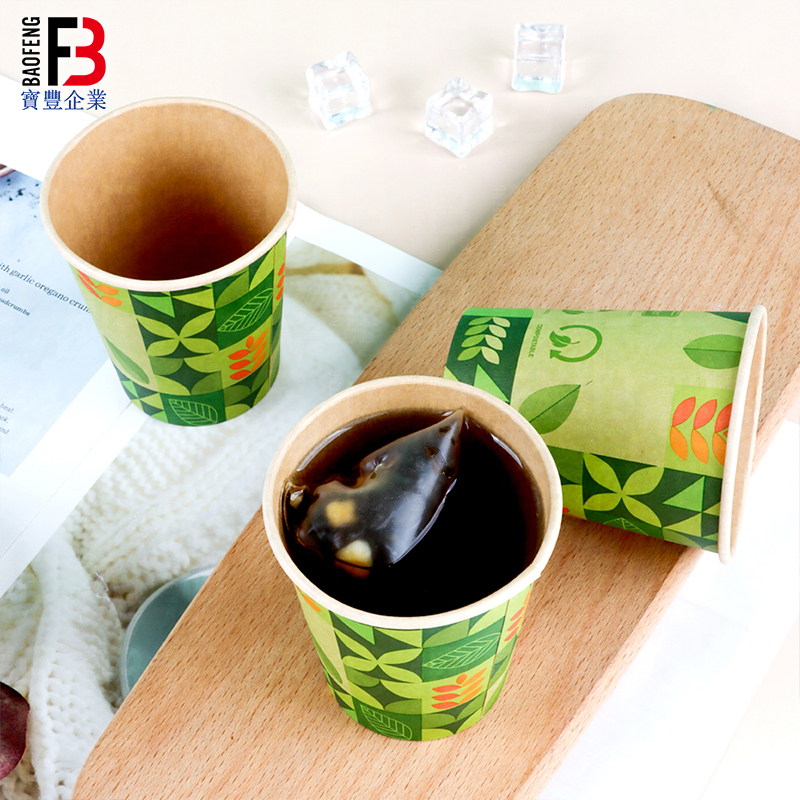
Next step: test both formats on your own serve
TopsPak (Wenzhou Baofeng Packaging Technology Co., Ltd.) produces both single-wall and double-wall paper cups under one roof, with OEM and ODM custom printing, PLA or PE coatings, and capacities from 4 oz to 20 oz.
- Email: kitty@baofengchina.net
- WhatsApp: +86 18867778878
- Website: www.takeawaypak.com
- Full product range and specifications: download the TopsPak catalogue (PDF)
Have Questions or Need More Details?
Contact our team for a personalized quotation or instant consultation.
Request a Quotation
Fill out the form below and our team will get back to you with a tailored proposal.
WhatsApp Direct Chat
Prefer to chat in real-time? Message us on WhatsApp for instant assistance & quick answers.
- Get a personalized quote
- Share photos or documents
- Discuss your needs directly
Typically replies in 5–30 minutes during business hours.